 Course Québec
Terry Fox is probably the most iconic runner in Canadian history. Not because he broke a world record — he never did — but because he ran a marathon a day for 143 days on an artificial leg, while knowing he had cancer. His Marathon of Hope ended before the finish line, but the movement he launched continues 45 years later and has raised over one billion dollars for cancer research.
For Québec runners, his story remains an essential reference. The annual Terry Fox Run, held in more than fifty communities across Québec every September, is the occasion to rediscover the remarkable journey of a young man who, at 21, decided he wouldn't stand on the sidelines.
Terrance Stanley Fox was born on July 28, 1958, in Winnipeg, Manitoba. His family moved to British Columbia when he was still a child, and he grew up in Port Coquitlam, a suburb of Vancouver. A passionate athlete, he played basketball and baseball in high school despite his modest size. That determination — refusing to let physical constraints dictate what he could achieve — would foreshadow what came next.
In November 1976, at 18, Terry was involved in a car accident. The pain he felt in his right knee afterward never fully went away. In March 1977, the diagnosis came: osteosarcoma, an aggressive bone cancer. A week later, his right leg was amputated about 15 cm above the knee.
In the hospital during chemotherapy, he was around other cancer patients — particularly children. The experience marked him deeply. He decided he would do something for them.
In 1979, after 14 months of training, Terry completed his first walking-running marathon in Prince George, British Columbia. His prosthesis — a rudimentary metal blade for the time, without the comfort of modern carbon-fiber prosthetics — produced a very distinctive gait: two small hops on the good leg, then a step on the prosthesis. This exhausting mechanic would leave blisters, bleeding, and bone cysts throughout the upcoming run.
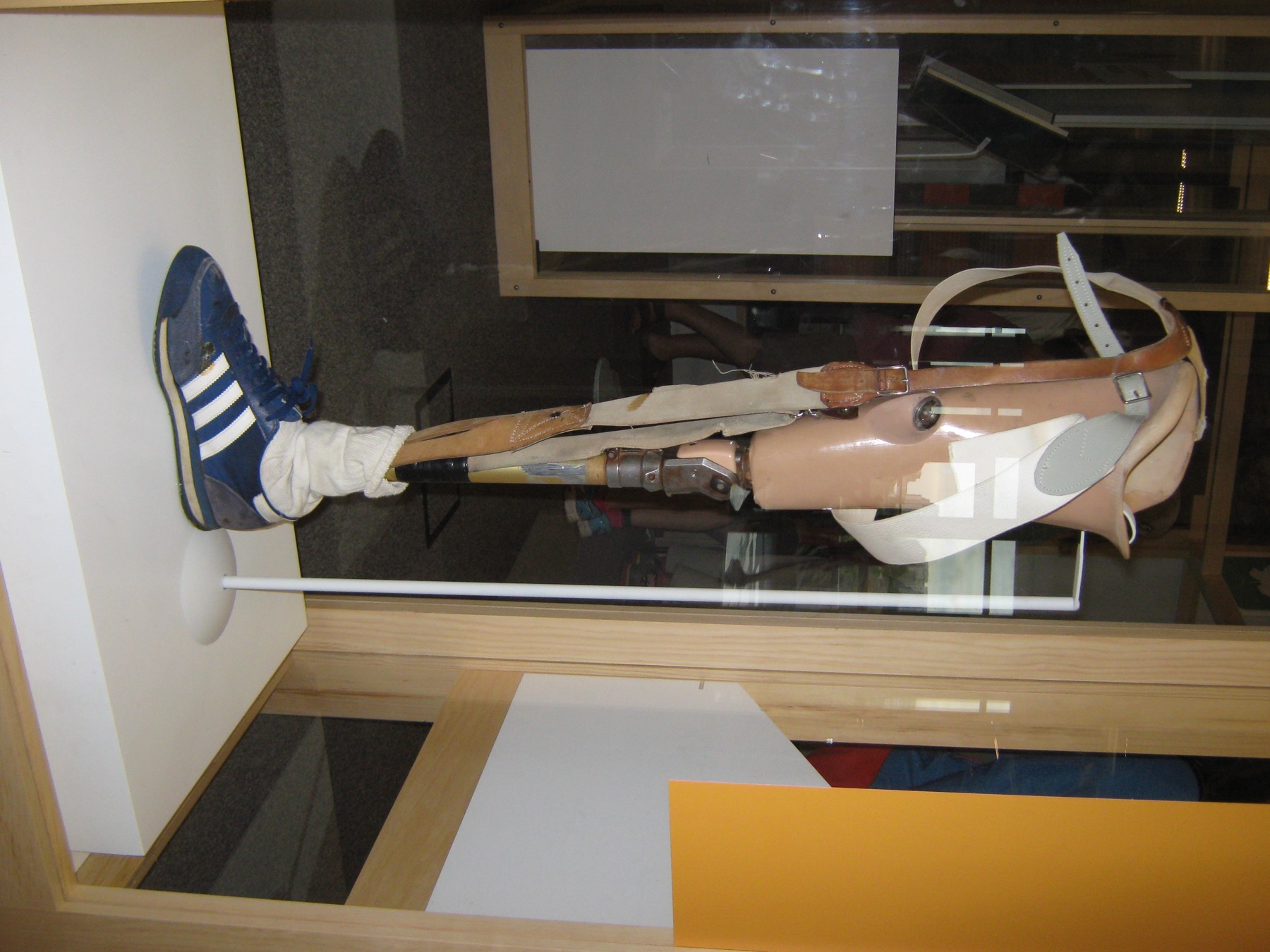
Terry had an ambitious plan: run across Canada, from Newfoundland to British Columbia — about 8,000 km — to raise one dollar for every Canadian (24 million dollars at the time) for cancer research. When he told those around him, most thought it was impossible. He persisted.
On April 12, 1980, Terry dipped his prosthesis in the Atlantic Ocean in St. John's, Newfoundland. He took two small bottles of seawater: one he emptied along the way, the other he planned to pour into the Pacific at the end. He left with a van, his childhood friend Doug Alward as driver, and very little media attention. Nobody was talking about him yet.
The pace he set was brutal: about 42 km a day — the equivalent of a full marathon — seven days a week. He woke at 4 a.m., ran until midday, ate, gave interviews, ran again, and finished before nightfall. No rest day.
The first weeks were grueling: snowstorms in the Maritimes, media indifference, few donations. Everything changed in Québec. When Terry crossed Montreal in June, national attention took off: TV reports, crowds awaiting him, donations pouring in. From Toronto onward, it was a wave of popular support. Cities organized to welcome him, schools lined up to see him pass.
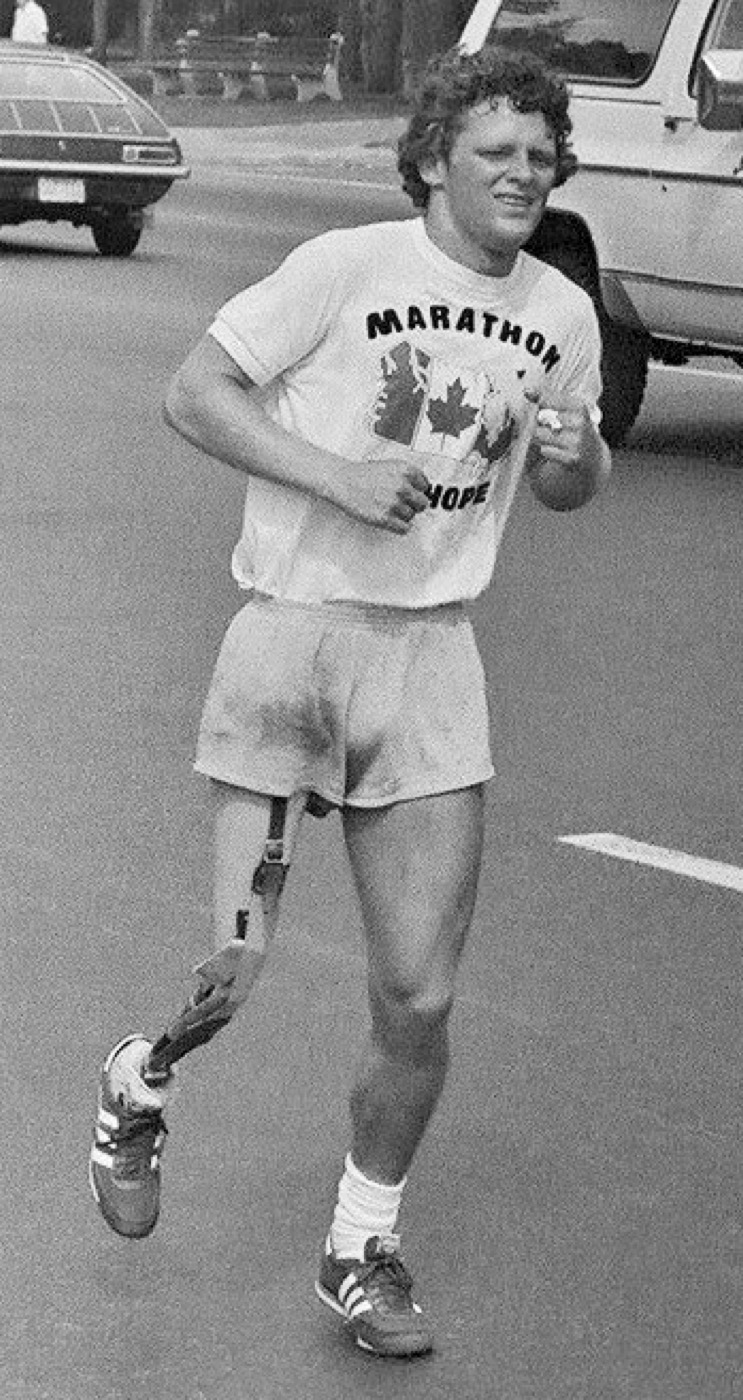
On September 1, 1980, on the outskirts of Thunder Bay, Ontario, Terry had to stop. He had run 5,373 km in 143 days — the equivalent of 128 back-to-back marathons. A persistent cough he had developed turned out to be far more serious than a cold: the cancer had spread to his lungs. The image of his press conference that day, where he announced he had to interrupt his journey through tears but without abandoning the goal — "if I don't finish, someone else will" — moved the entire country.
Terry Fox died on June 28, 1981, in New Westminster, British Columbia. He was 22, less than 10 months after stopping his run. Before his death, the country mobilized: a CTV telethon held in September 1980 raised over 10 million dollars in one evening. And the initial goal — one dollar per Canadian, 24 million — was reached in February 1981, a few months before he passed.
The first Terry Fox Run was held on September 13, 1981, three months after his death. Over 300,000 people participated in that first year, raising 3.5 million dollars. Since then, the event takes place every second Sunday of September in hundreds of communities across Canada — and in over sixty countries worldwide.
The format is intentionally simple: no competitive registration, no clock, no prizes. You walk, run, cycle, or push a wheelchair. The distance varies by city (often 1 km, 5 km, or 10 km). It's the exact opposite of a performance race: everyone is equal, and what matters is taking part.
As of February 2026, the cumulative total raised in Terry Fox's name exceeds 1 billion Canadian dollars, primarily channeled to the Terry Fox Research Institute. It is the largest grassroots philanthropic effort in Canadian history for cancer research.
Terry Fox's face appears on Canadian coins (the 2005 dollar, commemorative coins). More than fourteen schools, nine parks, two roads, a British Columbia mountain, and a Coast Guard icebreaker bear his name. A bronze statue stands in front of Parliament Hill in Ottawa, next to the National War Memorial.
Terry's passage through Québec in June 1980 was a turning point. This is where francophone media first picked up the story and national attention took off. Several Québec municipalities have a commemorative plaque or a street named after him marking his passage. The Terry Fox Foundation publishes the annual list of participating Québec races.
Terry Fox's story reminds us what the 5K, 10K, or marathon can mean beyond the clock. Many Québec runners sign up for charity races — the Pharmaprix Women's Run, the Montreal Marathon supporting various causes, or precisely the Terry Fox Run — precisely because the athletic gesture becomes a carrier for something else.
The event takes place on the second Sunday of September in over fifty Québec communities: Montreal, Quebec City, Sherbrooke, Trois-Rivières, Gatineau, Saguenay, Drummondville, and many smaller cities. Registration is free: a donation is suggested instead, and every dollar goes to research. Children and families are particularly welcome — it's one of the rare races where a stroller, wheelchair, or leashed dog is an integral part of the event.
Terry Fox only ran once, for 143 days. But what he set in motion — an annual race in sixty countries, over a billion dollars for research, a plaque in front of Parliament — proves that a single athletic gesture, carried out with conviction and perseverance, can lastingly transform society. For a Québec runner, running a 5K in September means stepping into that continuity.
Primary biographical source: Terry Fox article on Wikipedia (consulted June 2026). Images via Wikimedia Commons — see attributions under each photo.
The calendar of charity and themed races in Québec, including the annual Terry Fox Run in September.
Featured image: Simon Fraser University — Communications & Marketing, CC BY 2.0 via Wikimedia Commons. Inline photos: public domain (Jeremy Gilbert for Toronto 1980, Gbuchana for the prosthesis).


